
Kinetic Metallization: Coatings once thought impossible
KM HF Series
- Wear Resistance
- Corrosion Resistance
- Oxidation Resistance
- Hard Chrome Alternative
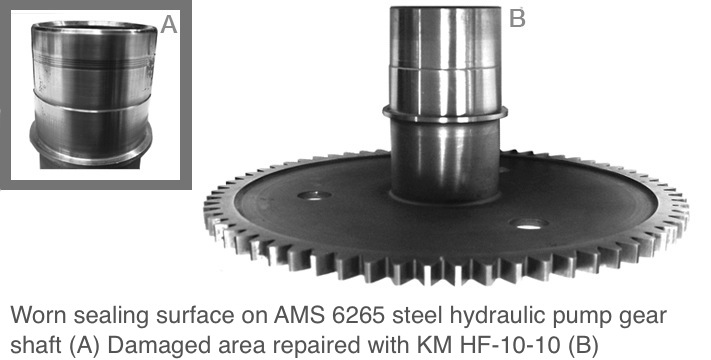
- Repair and Restoration
- Tank Armor Plate Repair
- Vehicle Tie Rod Repair
- Aircraft Landing Gear Repair
KM HF-10-10 Characteristics
- Lower cost than HVOF
- Does not require surface prep
- Smooth bondline
- Superior as deposited finish
- Minimizes grinding/ polishing
- Useful on thin substrates
- Tunable hardnesss: 700-1500HV (300g)
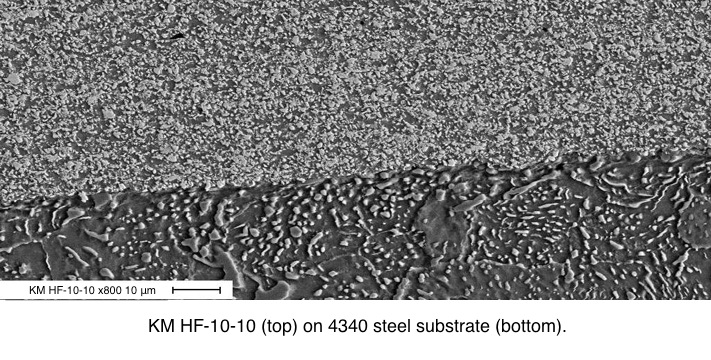
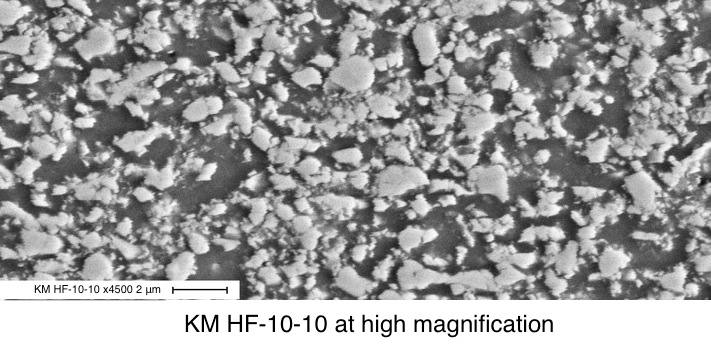
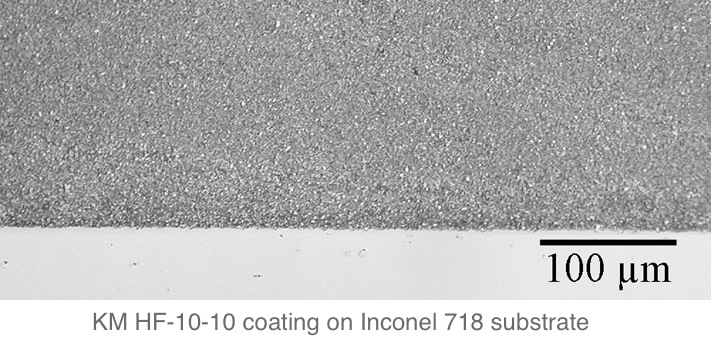
- Ultrafine microstructure
- Thickness: 0.001"-0.050"
- Environmentally Safe: No Carcinogens
- Fully Dense: 99%
Tungsten Carbide Cobalt
Tungsten Carbide Cobalt coatings were introduced to the industrial world as a hard coating for the repair of shafts. Originally as a plasma spray feedstock and more commonly today as an HVOF feedstock. These coatings have proved themselves in a variety of industrial applications, mainly as hardface, or wear resistant coatings. However, plasma and HVOF processes require very high deposition temperatures which requires feedstock of a large particle size (45-100 microns). Additionally, the high temperatures limit the types of substrates that can be coated due to heat load on the substrate which leads to thermal distortion of the part and melting, especially in ID coating applications. By contrast, Kinetic Metallization WC-Co has an extremely fine particle size (maximum 3 microns). This is possible because of the low temperature, high velocity impact consolidation process. The result is a coating of equal hardness and superior wear resistance, and due to its fine particle size, the coating needs less grinding in order to be finished to the required 1 micron surface roughness. Moreover, KM feedstock, although chemically identical to HVOF/plasma feedstock, is about 20% less costly and is desposited at a higher deposition efficiency.